
Summarize this blog post with:
What’s in the blog
❒ How converged data platforms eliminate integration debt and unify fragmented data ecosystems.
❒ How CDPs enable AI-ready data access and accelerate time-to-insight for competitive advantage.
❒ How the three-layer architecture delivers governance, intelligence, and seamless user experience.
❒ How enterprises can adopt converged platforms through a practical 5-phase implementation framework.
Your data is split across several clouds, including Azure, AWS, GCP, Snowflake, and Databricks. This creates confusion because there are a lot of different data management systems involved.
Most organizations manage over a dozen overlapping ETL, quality, governance, catalog, and pipeline tools that don't integrate well, driving up costs, complexity, and vendor management burden while leaving data siloed. 81% of IT leaders report these silos hinder digital transformation, delaying critical AI-ready data delivery-including for agentic AI that requires comprehensive, consistent access across all sources on demand. Teams spend more time troubleshooting integrations than creating business value.
The solution? Converged data platforms that unify the entire data stack for scalable AI, eliminating integration debt at its root.
Converged Data Management Platforms allow you to combine the full data stack, including storage, integration, governance, quality, and AI into one unified infrastructure rather than connecting multiple disjointed applications together as many organizations do today.
As the urgency to adopt Converged Data Platforms continues to grow, the projected increase in CDP adoption from 2025 - 2032 is estimated to grow at a 14% compound annual growth rate.
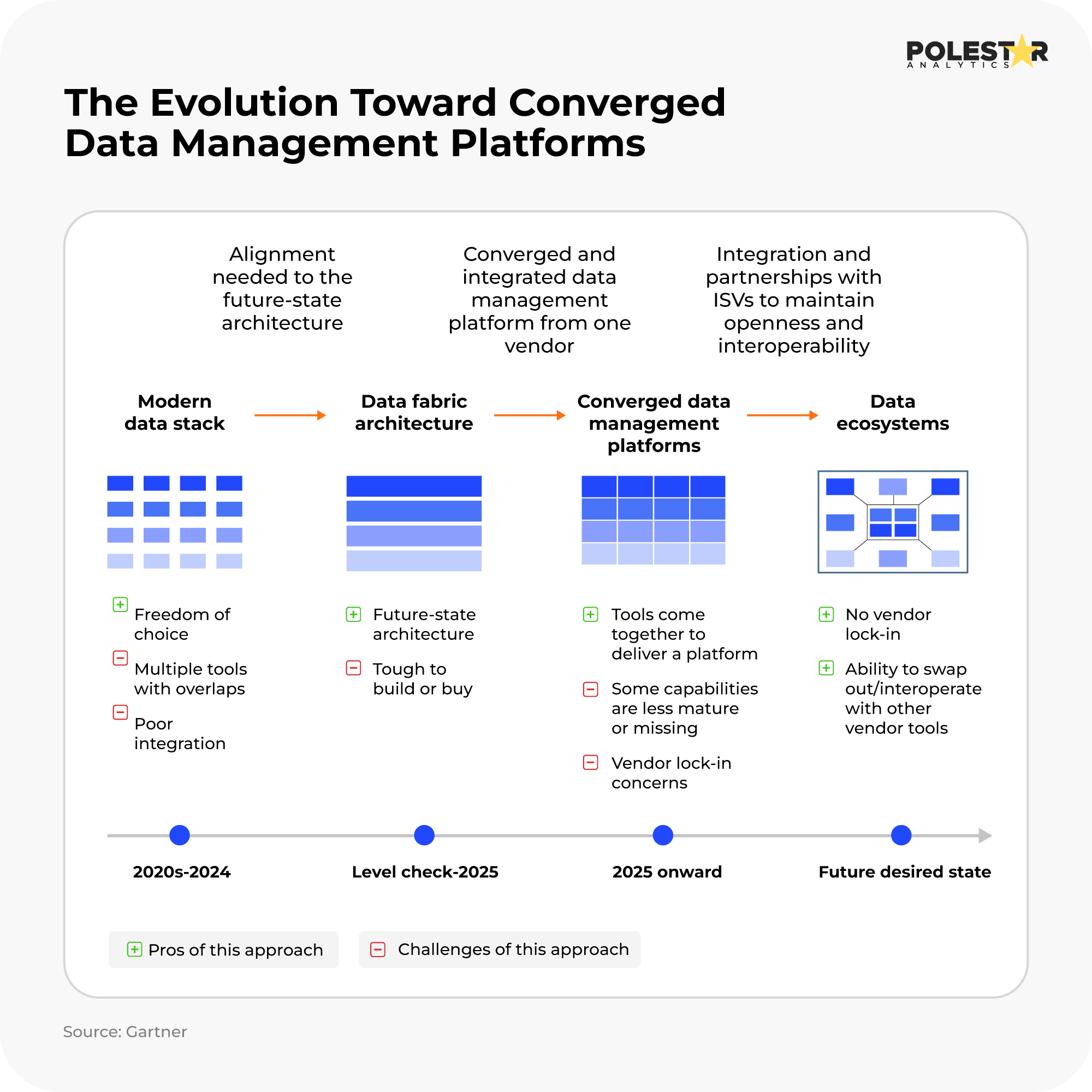
Trust Gaps from Invisible Data
Data executives claim full visibility into inventory, but business leaders disagree, creating perception disconnects that erode fundamental trust, no matter how many governance documents exist.
Integration Debt Accelerates Complexity
Multiple overlapping tools spawn "integration debt"-the mounting cost of linking incompatible systems. Each added solution multiplies licensing fees, custom connectors, training demands, and vendor coordination.
Speed Kills Opportunity
66% miss opportunities from delayed access, with 54% wasting 2+ hours daily just searching for information. Competitors deciding in hours outpace teams validating data for days.
These challenges aren't just operational inconveniences-they translate into tangible business value when addressed through converged platforms.
When used properly, converged data platforms provide significant advantages throughout your organization:
➣ Enables Smarter AI Outcomes with Governed, Comprehensive Data Access
Gartner's survey finds 61% of organizations are evolving their D&A operating model specifically for AI. Converged platforms provide AI systems with:
- Complete context across all organizational data.
- Consistent semantics and standardized business logic.
- Real-time data availability when agents need decisions.
➣ Operational Efficiency at scale
- Consolidation delivers immediate operational wins:
- Unified monitoring: One dashboard instead of logging into ten different tools.
- Consistent deployment: CI/CD workflows that work across all data processes.
- Native connectivity: Eliminating custom integration code.
- Reduced training burden: Teams master one platform instead of multiple tools.
➣ CDPs speed up the data-to-value process with secure, governed access
Secure platforms help speed up trusted data access. They reduce the time needed to gain insights and support quick, practical decisions. This method moves organizations from merely spotting problems to being able to carry out solutions.
➣ The most profound shift: converged platforms move data teams from reactive troubleshooting to proactive value creation. After resolving the challenges associated with merging data, reconciling reports, and dealing with the subsequent issues created due to a lack of governance, teams will then spend more time developing data products, enable AI initiatives, and collaborating with their business partners on developing new ideas.
So while understanding these benefits is great, to fully leverage them, organizations must understand how converged platforms operate.
1. Governance and Data Reference Layer (Foundation)
This fundamental layer creates your data ecosystem as a "single source of truth" by:
- A Metadata Registry serves as a comprehensive database for metadata that keeps track of all available data, its location, its meaning, and what can be done with it.
- The term "Pipeline Management" refers to managing the various steps of data flow and conversion between different environments.
- Operational Control: Monitoring, notifications, and error logging across all pipelines.
2. Data Enrichment Layer (Intelligence)
Transforms raw data into business-ready assets via:
- ML-driven Refinement: Machine learning algorithms and statistical calculations improve raw data by adding insights, flags, and indicators. This makes the data more helpful for decision-making.
- Usability Enhancements: Changes and improvements in data quality, along with adding meaning, prepare data for use by both human users and AI systems.
3. Interaction and Engagement Layer (Experience)
This layer provides:
- Persona-based Visualization: Interfaces that fit the needs of data engineers, analysts, and executives.
- Semantic Search: Natural language questions that reveal relevant data products.
- Self-Service Tools: Business users can use their own data and not require previous assistance from IT.
But the question now is, how can an organization implement a converged data platform?
Phase 1. Assess and Diagnose
Audit current landscape:
- List all data-management tools
- Identify overlaps, redundancies, and fragile integrations
- Calculate TCO across tools
Clear the priorities:
- Map critical data/AI use cases
- Identify pain points hurting business outcomes
- Surface friction points across teams
Quantify technical debt:
Time spent maintaining vs. delivering value
Integration failures & operational disruptions
Want to audit your data landscape and kickstart convergence?
Phase 2. Consolidate Foundations
Rationalize data persistence:
Polestar Analytics offers 1Platform that brings together your entire data ecosystem, from storage and integration to governance and AI support with:
1. Unified data fabric which connects Azure, AWS, GCP, Databricks, and Snowflake, all without moving data.
2. Low-code and no-code options allow business users work while keeping technical flexibility.
3. Built-in governance applies policies consistently across data environments, incorporating-these factors from day one:
- Open Standards support for Iceberg, Delta Lake, Hudi, Open APIs, OSS integration, and clear migration pathways with modular components.
- Embedded Governance via RBAC & ABAC controls, automated QA checks, metadata management, lineage tracking, and policy enforcement across the ecosystem.
- Adoption Acceleration through training, early use cases, change management support, and continuous feedback loops for business and technical users.
4. AI-ready architecture supporting agentic AI with comprehensive, governed data access.
- Reduce multiple DBMS/storage layers
- Move toward a unified data platform with multimodal persistence
- Eliminate immediate structural redundancy
Phase 3 - Build the Data Fabric Layer
Once persistence is stable, expand into:
- Unified data integration pipelines
- Standardized data quality & monitoring
- Metadata management + lineage
- Automated governance enforcement
These create a consistent fabric for trusted, governed access.
Phase 4 - Scale Advanced Use Cases
Enable higher-value capabilities:
- Real-time analytics & streaming
- AI/ML workloads with governed data
- Data-product marketplaces & self-service acceleration
- This is where the platform starts delivering exponential value
Phase 5 - Optimizing the Ecosystem
Keep improving and growing:
- Further consolidation where practical
- Integrate select best-of-breed ISVs
- Evaluate new open-standards and platform plug-ins
The convergence journey moves companies toward proactive intelligence by creating a unified data foundation. Most importantly, it allows for the human-AI collaboration that talks about the next era of business intelligence. When people drive strategy and machines manage mechanics, both can work from the same governed, real-time data. This collaboration opens up possibilities that neither could achieve on their own.
Converged platforms unify storage, integration, governance, quality, and AI across multimodal data beyond structured warehouses or raw lakes. Open standards like Iceberg, Delta Lake, and Hudi eliminate sprawl, creating a seamless fabric without data movement.
Overlapping tools create integration debt and AI delays. Converged platforms consolidate operations, cut vendor chaos, and open speed-freeing teams for value creation over maintenance.
Converged data platforms deliver data fabric architecture supporting real-time analytics, AI-ready data, and AI assistants through integrated metadata, governance, and streaming, shrinking time-to-insight for rapid decisions.